“Miles Davis “Kind of Blue,” Kind of Inspiring

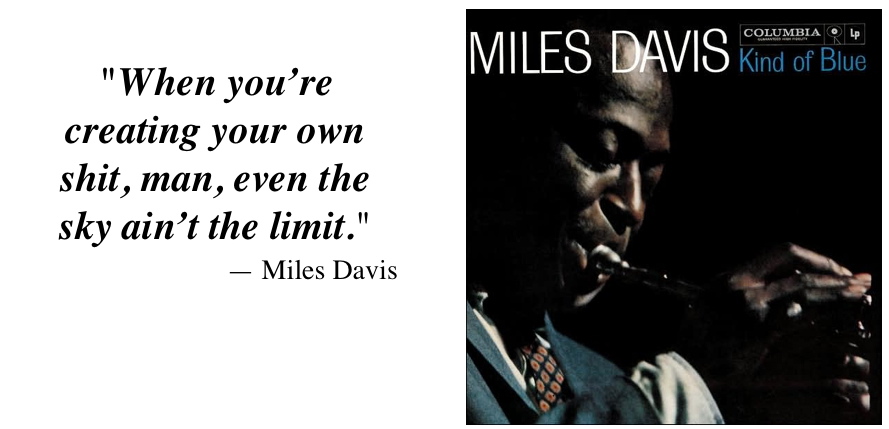
On August 17, 1959, Miles Davis released “Kind of Blue,” the best-selling jazz record ever and considered one of the most influential albums of all time.

“Kind of Blue” has become part of the soundtrack for my novel “For Purple Mountains.” I find the music beautifully rich and moving, but there’s more to it than just that.  The history behind the music inspires me to reach beyond what’s easily accessible.

Mr. Davis was well established and successful, but was starting to feel confined by the boundaries of the bebop and hard bop styles of jazz he played.  Rather than accepting the restrictions, he created his own shit, as he says above.  He didn’t travel the road less taken, he paved a whole new way.

Jazz pianist Chick Corea said, “It’s one thing to just play a tune, or play a program of music, but it’s another thing to practically create a new language of music, which is what “Kind of Blue” did.”

Using pianist George Russell’s theory of improvisation based on scales rather than chords gave the musicians the freedom to explore rhythm and melody.  Their explorations created modal jazz, and it’s influence rippled into musical genres as diverse as classical and rock ‘n roll.

I could go on about the endless, well-deserved accolades, but I’d rather let the music speak for itself.   I’m hopeful that others will hear it and be inspired to go out and create their own shit.  Blue in Green from “Kind of Blue.”

Fred Kaplan’s article on Slate features musical samples and an easy to understand explanation of Why Miles Davis’ Kind of Blue is so Great.

Happy Birthday, Mr. Bukowski

The “Laureate of American Lowlife,”  Time magazine called him.  Charles Bukowski would have been 90 years old today.  He died of leukemia on March 9, 1994 at the age of 73.  Pretty remarkable for a man who was told in his 20s to give up drinking or die.  He never did give it up, but he did take it much more seriously.  In a 1987 LA Times article, he said,

The wine does most of my writing for me.

That wasn’t just bravado.  He meant it.

“Don’t Try” is engraved on his tombstone.  What he meant, I think, is the theme of his poem, “So You Want to be a Writer.”  If you’re a writer, it’s a must read.

Bukowski falls into one of three categories: Love him.  Hate him.  Don’t know him.  Which one are you?

Want more? Visit Bukowski.net.

Learning to Love Poetry Can Strengthen Your Prose

Last week when I posted “When You Are Old” in honor of William Butler Yeats’ birthday,  I wrote that I sometimes use poetry to inspire my writing or help get the words moving when I’m stuck.

Writer Kevin Mackey and others who commented on the post said they do the same.

“I use poetry to remind myself of the beauty that can be wrung from language. It acts as a spur to my own efforts,” Kevin said.

Other comments and conversations I’ve had since then echo Kevin’s thoughts.  But it’s confession time:  I didn’t always like poetry.  I often felt it was inaccessible and that made me feel left out, annoyed, and a little bit dumb.

I stayed away for a while, but I knew there was value in poetry and that I could learn from it.  I wanted to find a way in.  Over time with some effort I finally did.  I’ve learned to appreciate poetry for its precision and imagery, and not strictly for its literal meaning.  “The Sounds of Poetry: A Brief Guide” by Robert Pinsky, former Poet Laureate was particularly helpful.  It’s a tiny book that uses examples to explain how poetry uses the sounds of words to convey meaning in a rich, melodic, and concise way that keeps the reader entranced.  As a writer, I aspire to that.

To use poetry to strengthen your writing, consider these elements that help make a poem a poem.

Sound: As Pinsky says in “The Sounds of Poetry,” poets use the sounds of words to make an impact.  That can be done through repetition, alliteration, assonance, varied word lengths, onomatopoeia, and on and on (and on).

Try it in your own writing.  Are you working on something that is light-hearted? High drama? Horror? Choose words to convey that feeling, not based simply on meaning, but based on sound.  Do it in an over-exaggerated way.  Let yourself have fun with it.  You can fix it in revision, but you might find that what you’ve come up with is strong and vivid.

Precision: Don’t stop at using the right word or getting the scene right.  Keep on writing (and rewriting) until it conveys the most information without overwhelming.  Think about what other senses can be alerted to engage the reader.  If your character is nervous, how can you show it through his senses.  He feels his hands shaking.  He hears his heart pounding.

Precision doesn’t stop there.  Prose does not have the format limitations of poetry, but it’s equally important to avoid unnecessary words, whether in the form of clichés, useless adjectives, or  pleonasms, a form of redundancy, such as past history and consensus of opinion.

Of course, there is far more to poetry than just sound and precision, but adding these two elements to your writing and revising will make a richer experience for  you and your reader.

For information on “How to Read a Poem (and Fall in Love with Poetry),” this post from the Poetry Foundation is loaded with great insight.  It’s a wonderful site, too!

June 16: It’s Bloomsday Yes it is Yes Enjoy Yes

Today is Bloomsday, June 16, the day all the events in James Joyce’s Ulysses take place.

Named for main character Leopold Bloom, Bloomsday is celebrated by Joyce fans around the world, with a huge celebration in Dublin, where the book is set.  Fans spend the day honoring Joyce, reenacting scenes from the novel, and generally having a wild time.

Molly Bloom, Leopold’s wife is lusty and seductive, even crude in comparison to Leopold’s more cerebral nature.  Both Blooms have had affairs and at the end of the book they continue to question the value of their marriage.  Yet in Molly’s 24,000 word unpunctuated stream of consciousness soliloquy that ends the novel, it’s hard to deny the joy she finds at the hands of her husband.

In honor of Bloomsday, the final words of Molly’s soliloquy:

… Yes when I put the rose in my hair like the Andalusian girls used or shall I wear a red yes and how he kissed me under the Moorish wall and I thought well as well him as another and then I asked him with my eyes to ask again yes and then he asked me would I yes to say yes my mountain flower and first I put my arms around him yes and drew him down to me so he could feel my breasts all perfume yes and his heart was going like mad and yes I said yes I will Yes.

Happy Bloomsday, everyone.  Yes?

Enjoy Freedom of Speech? Thank John Milton


A good book is the precious lifeblood of a master spirit, embalmed and treasured up on purpose to a life beyond life.
……………………….—  John Milton

On June 14, 1643, the Parliament of England passed a Licensing Order that put publishing under government control.  The Order forced authors to submit their work to official censors for approval before publishing.

The Order was intended to preserve the publishing monopoly held by The Stationers’ Company, but in effect and in practice, it gave the government authority to control free thought via rigid censorship.

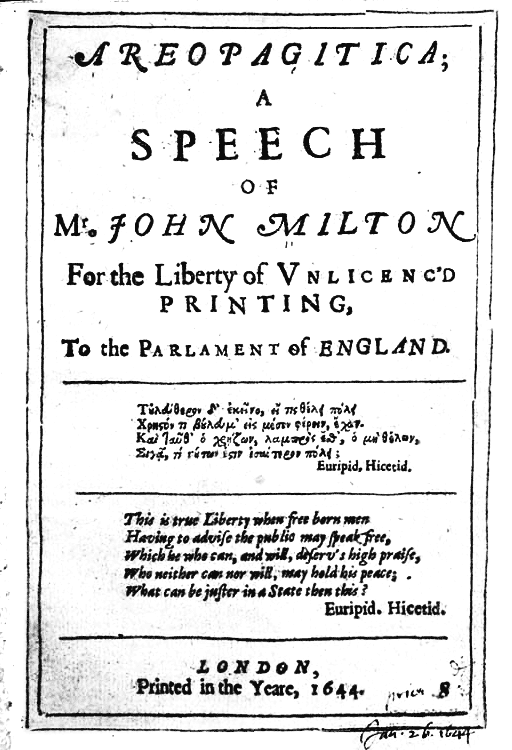
John Milton, who later wrote the epic poem Paradise Lost was called to action when he felt the strong arm of government enforcement after publishing his writings in favor of divorce.  In response he wrote Areopagitica, a passionate and enduring essay on the right to freedom of speech and expression.  Civil liberty, Milton reasoned, is attained through the open discussion of ideas and grievances.

Areopagitica, though widely acknowledged, had little influence on Parliament’s Order, but its importance was never forgotten.  The essay has endured as one of the most important and influential essays of free speech ever written, and it was crucial in the development of the First Amendment of the Constitution:

Congress shall make no law respecting an establishment of religion, or prohibiting the free exercise thereof; or abridging the freedom of speech, or of the press; or the right of the people peaceably to assemble, and to petition the Government for a redress of grievances.

United States Constitution – Amendment 1

In its eloquence, Areopagitica says that truth, all truth, need only to be heard, openly and fairly, to assure its victory over ignorance.

That is a timeless truth.

If you’re as uncertain about the pronunciation of Areopagitica as I was, this YouTube video can help.

For Yeats: When You are Old and Gray …

A few weeks ago, I posted “Distractions, failures? Yeats had them, too,” about my visit to the National Library of Ireland, and what I learned about William Butler Yeats while I was there.

Today is Yeats’ birthday, so to honor him and spread the joy I’ve had in reading his poetry, I’m sharing one of his poems.  This is one of my favorites, both for its theme and for its slow, ethereal beauty.

When You Are Old

When you are old and gray and full of sleep,
And nodding by the fire, take down this book,
And slowly read, and dream of the soft look
Your eyes had once, and of their shadows deep;

How many loved your moments of glad grace,
And loved your beauty with love false or true,
But one man loved the pilgrim soul in you,
And loved the sorrows of your changing face;

And bending down beside the glowing bars,
Murmur, a little sadly, how Love fled
And paced upon the mountains overhead
And hid his face among a crowd of stars.

Reprinted courtesy of poetry-archive.com.

At times, when I’m having difficulty getting the words right or my writing isn’t flowing, poetry helps me break through.  It gives me the in.  I don’t know if it’s the beauty of the words or the lyrical flow, but it opens up that part of my brain that’s not so uptight and rigid, and it allows me to write.

Do you use poetry this way? Do you have any favorite poems that stir your creativity?  Please share them here.

To learn more about William Butler Yeats or read more of his poetry, please visit the Yeats Society.

Happy Birthday to Anne Frank and her Diary

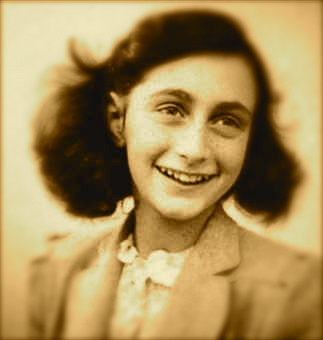
On June 12, 1942, 68 years ago today, Otto Frank gave his daughter, Anne, a diary for her 13th birthday.

Anne began a chronicle of her life that day and wrote most of her diary in hiding at the Secret Annex, a tiny hidden compartment behind a bookcase at her father’s office, where her family and four others were forced into hiding from the Nazis.

Anne wrote about the difficulties of living with eight people in such a confined and secret space. She shared her fears of being discovered by the Nazis.  And she wrote about her life as any 13 year old girl would, the excitement and confusion, the hopes and disappointments.

Anne’s dairy ended on August 1, 1944.  Three days later, the German Security Police followed an anonymous tip and raided the Secret Annex arresting everyone there.  Anne, her sister Margot, and their mother Edith were eventually sent to Auschwitz along with one thousand other women.  Half were sent directly to the gas chambers.  Anne, Margot, Edith, and the remaining 500 were forced to strip and be disinfected, have their heads shaved and their arms tattooed with an identifying number.

Edith died at Auschwitz after Anne and Margo were moved to Bergen-Belson.  Seven months later, Anne watched her sister die of typhus.  She died one week later, just a few weeks before the camp was liberated by British troops on April 15, 1945.  Only Anne’s father survived.

The Diary of a Young Girl, Anne Frank’s diary, has been translated into 67 languages and is one of the most widely read books in the world.

Its importance is noted in its inclusion on these lists:

Anne’s work speaks for itself.  It puts a human face, a young girl’s face, on the unimaginable suffering of the Holocaust.  We are graced by it because Anne Frank put her words on paper.

Friday Flash: OMG at Barnes & Noble

© Olivia Tejeda

“Oh my God,” Fredrika’s husband gasped as she approached the table where he sat reading “The Portable Jung” at the Barnes & Noble cafe.

“What’s wrong with this?” she asked holding out the copy of Oprah she brought back with her.

Her husband looked up, eyes only, over the top of his glasses.  He said nothing and went back to reading.

She leaned in and said through tight lips and a clenched jaw, “I asked you if there’s something wrong with this.”

No response.

“Edward!” Louder this time.

Edward closed the book and slid his glasses down.  He pondered the pinched looking woman standing in front of him as he stroked his short salt and pepper beard.

“Can I … help you?” he said.

“Why did you say ‘Oh my God?’ ”

“You are truly pathetic.”

“Wrong again, Edward,” she said, pointing a sharp finger at him.  “You are an impotent troll.”

Fredrika sat down and noticed the woman at the next table, caught mid-sip and still staring, surprised and embarrassed by their candid contempt.  Fredrika smiled and began flipping the pages of the magazine.

Flip.  Flip, flip.  Flip.

“Did I do something?” she said.  “Is that why you said ‘Oh my God?’ ”

Edward sighed. “Really, Fredrika? Really?”

“Just tell me.”

“I’m reading.”

Flip, flip, flip.

“Want pizza for dinner?” she asked.

Edward grunted.

“Chinese? You want Chinese?”

Silence.

She flipped more pages.

“We can have dinner with the Crandalls.  You like the Crandalls.”

“Fredrika,” Edward said.

“Hmm?”

“Fredrika,” he said

“Edward,” she said.

“Fredrika,” he said.

“What?” she hissed.

“Can I tell you what I want?”

She sat mute.

“I want you to shut up,” he said.  “For one minute of one day in the entirety of your life, I want you to shut your mouth and be silent.”   Then he went back to reading.

Fredrika huffed and straightened her posture.

Flip.  Flip, flip.

After flipping the last of the pages, she took a deep breath and rubbed her forehead.

Edward looked up.  “Are you all right?” he asked.

“My contacts are bothering me.”

“Do you want to leave?”

“I hate to disturb your book, but yes, yes, I think so.”

He closed the book and stood up.

“Here,” he said reaching out.  “Give me your magazine.  I’ll put it away for you.”

When he returned, he took her hand and they walked together to the exit.

Thank you for reading.  To read more flash fiction from a great group of writers, search #fridayflash on Twitter or visit Mad Utopia.

Guest Blogger: Deanna Schrayer

Please welcome guest blogger, Deanna Schrayer, who is sitting in with The Silent Writers Collective today to talk about writing when it seems like there’s no time.  She speaks from experience.  Read on.

Find the Time and the Words Are Sure to Follow

[picapp align=”right” wrap=”true” link=”term=clock+and+computer&iid=5279794″ src=”http://view.picapp.com/pictures.photo/image/5279794/hand-man-using-pen/hand-man-using-pen.jpg?size=500&imageId=5279794″ width=”234″ height=”206″ /]

“Raising a teenager is like trying to nail jello to a tree.”

The same could be said for those of us who work, raise a family, and write.  As a mom to two sons, a wife, a full time employee, a volunteer, and owner of too many pets, there are times when I wonder how I’m supposed to find the time.

As writing has become more important to me, I’ve tucked a few tricks up my sleeve and would love to hear yours, too.

Everyone has the same amount of time; it’s what you do with it that matters.  When I feel the need for a break during work, I turn my instant messaging to “I am away,” and I spend fifteen minutes writing.  It doesn’t matter what I write, as long as I write.

To ensure I use that break to write, I schedule a recurring appointment on my calendar; when the reminder pops up, no matter what’s going on, I stop what I’m doing, and start writing.  Trust me, if I can do this, so can you.  Not only will it get you writing, it’s a useful way to develop the writing habit.

Just rewards
The best method I’ve discovered to guarantee I accomplish my goal is to reward myself.  This can work for you, too.

Each morning decide how you’re going to reward yourself.  Make sure the reward is something you really want. Mine is often a bowl of ice cream.  Write your reward on a Post-It and put it where you’ll see it throughout the day.  This little action will plant in your brain that you must use your break to write if you want to receive that reward.  Absolutely do not allow yourself the reward if you haven’t written.  This will also teach you self-discipline, something all writers must possess.

If you’re constantly interrupted at work, go to a different area for your writing break. If that isn’t possible, learn how to get rid of the interrupters. For tips on how to do this tactfully, read the “Ignore the Gossips” portion of my blog post, How Do You Organize Your Day?

If writing on your work break doesn’t suit you, find the time that works best for you, and stick with it. Maybe you’re a morning person, maybe you’re a night person – it doesn’t matter. Whatever time of day you feel most alert, schedule that time, even if it’s a mere fifteen minutes, turn the world off, and write.

Do. Nothing. Else.

The importance of community
Most importantly, be sure to connect with other writers.  Knowing we aren’t alone gives us the motivation to keep writing, no matter the stumbling blocks thrown our way. That’s where groups like the Silent Writers Collective comes in, groups that give us a place to share our challenges and celebrate our successes.

Another fantastic group is #Writers_Life, created by Anne Tyler Lord of Don’t Fence Me In.   And let’s not forget the wonderful #FridayFlash community created by J.M. Strother of Mad Utopia.

Another inspiring site I’ve discovered is storyfix.com by author Larry Brooks.  While storyfix.com isn’t a community, Larry’s posts are inspiring and educational.  I’ve learned a lot by reading his blog.

Keep in mind, if you write one sentence, you have written.  I’m not always blessed with happily flowing fingers during my scheduled writing time, but I am always blessed with at least one sentence.  One sentence leads to another.  There are 365 days in a year.  365 sentences could make for a darn good story.

Deanna’s stories and poetry have been featured in Soft Whispers Magazine as well as local literary and arts review publications. She contributes nostalgic short stories to a local newspaper. Deanna is currently writing her first novel. You can find her creative nonfiction at The Life of a Working Writer Mommy, and her fiction at The Other Side of Deanna. Deanna loves hearing from her readers, so stop on in!

Join the SWC on Tuesdays at 9 PM Eastern and/or 9 PM Pacific (US) for the next Silent Write-In.

When it Comes to Writer’s Block, Sleep On It

[picapp align=”right” wrap=”true” link=”term=sleep+dream&iid=1253981″ src=”1/e/a/5/3b.jpg?adImageId=13066973&imageId=1253981″ width=”234″ height=”241″ /]

For writers it is like a mantra.  In order to write, you must to take the time, sit down, and do it.

BIC HOK TAM, right?

Well, it’s true.  There are no short cuts. Magic formulas are available for purchase, but on the whole, they don’t really work.  Call me a cynic.

Writing takes an enormous amount of time and dedication.  Most writers will tell you that struggle ranks high in the job description, or as sportswriter Red Smith said:

There’s nothing to writing.  All you do is sit down at a typewriter and open a vein.

But what happens when you’ve opened a vein (or 3 or 4) and you’ve still got nothing?  What do you do when even those special prompts saved for desperate moments like this fail you?

My solution?  Take a nap.  Read a book.  Make Rice Krispie treats.  Do anything but write, because your creatively clogged brain is trying to telling you that it needs some time for itself.

When I need to get away from writing, my favorite diversion is napping, and I’m happy to say I’ve got science on my side.

A study by researchers at UCSD found that REM sleep was 40% more effective than the simple passing of time or quiet rest to enhance creativity, in particular for new problems. (1)

During a time when I wasn’t writing anything more than memos at work, my current WIP, a novel now titled For Purple Mountains, came to me in a dream.  It was far from complete, but it intrigued me enough to get me writing again.  Two years later, I’m still at it … happily … most of the time.

Other sleep-induced inspirations include:

  • The tune for Yesterday, which came to Paul McCartney in his sleep.  (If you watch that video, let me know if you agree that Paul is so adorable!)
  • Golfer Jack Nicklaus’ whose career was crumbling.  In a dream he saw himself holding the club differently.  When he tried the new grip later, his game improved dramatically and he was back on top again.
  • The Strange Case of Dr. Jekkyl and Mr. Hyde, which was plotted in a dream by Robert Louis Stevenson.
  • Mary Shelley, who is said to have been inspired by a dream to create Frankenstein.

Of course, these are big, definitive examples, but how many of us have woken up with a solution to a problem that at one time seemed unsolvable?

Sleep or otherwise walking away from your writing, isn’t always the solution because if you’ve committed any serious time to writing, you know it doesn’t always flow, and sometimes you just have to give it time.  But for those excruciating moments, when you know you’re completely stuck, walk away.  Then, when you’re rested, go back to your writing and open up another vein.

Join The Silent Writers Collective on Tuesdays at 9 PM Eastern and/or 9 PM Pacific (US) for the next Silent Write-In.
For a basic Rice Krispie Treat recipe, try Cooking for Engineers, one of my favorite recipe sites.  It’s quirky, with a touch of OCD and every recipe I’ve used from the site comes out perfectly.