“Miles Davis “Kind of Blue,” Kind of Inspiring

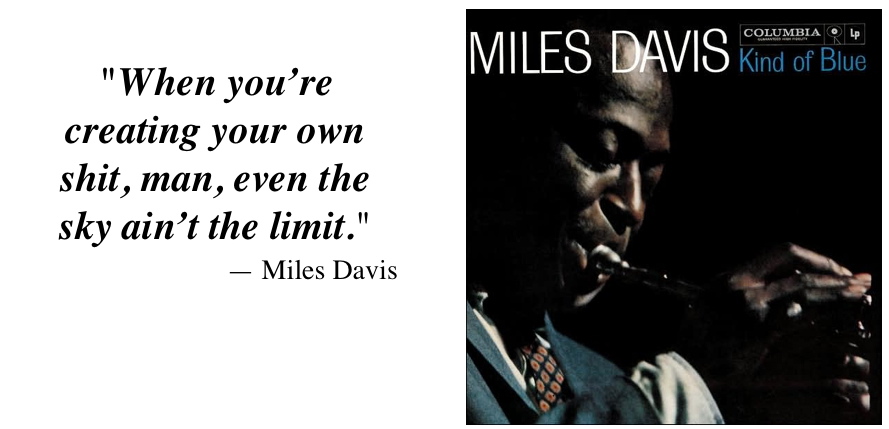
On August 17, 1959, Miles Davis released “Kind of Blue,” the best-selling jazz record ever and considered one of the most influential albums of all time.

“Kind of Blue” has become part of the soundtrack for my novel “For Purple Mountains.” I find the music beautifully rich and moving, but there’s more to it than just that.  The history behind the music inspires me to reach beyond what’s easily accessible.

Mr. Davis was well established and successful, but was starting to feel confined by the boundaries of the bebop and hard bop styles of jazz he played.  Rather than accepting the restrictions, he created his own shit, as he says above.  He didn’t travel the road less taken, he paved a whole new way.

Jazz pianist Chick Corea said, “It’s one thing to just play a tune, or play a program of music, but it’s another thing to practically create a new language of music, which is what “Kind of Blue” did.”

Using pianist George Russell’s theory of improvisation based on scales rather than chords gave the musicians the freedom to explore rhythm and melody.  Their explorations created modal jazz, and it’s influence rippled into musical genres as diverse as classical and rock ‘n roll.

I could go on about the endless, well-deserved accolades, but I’d rather let the music speak for itself.   I’m hopeful that others will hear it and be inspired to go out and create their own shit.  Blue in Green from “Kind of Blue.”

Fred Kaplan’s article on Slate features musical samples and an easy to understand explanation of Why Miles Davis’ Kind of Blue is so Great.

Happy Birthday, Mr. Bukowski

The “Laureate of American Lowlife,”  Time magazine called him.  Charles Bukowski would have been 90 years old today.  He died of leukemia on March 9, 1994 at the age of 73.  Pretty remarkable for a man who was told in his 20s to give up drinking or die.  He never did give it up, but he did take it much more seriously.  In a 1987 LA Times article, he said,

The wine does most of my writing for me.

That wasn’t just bravado.  He meant it.

“Don’t Try” is engraved on his tombstone.  What he meant, I think, is the theme of his poem, “So You Want to be a Writer.”  If you’re a writer, it’s a must read.

Bukowski falls into one of three categories: Love him.  Hate him.  Don’t know him.  Which one are you?

Want more? Visit Bukowski.net.

Curiousity, Responsibility and “The Little Prince”

On ne voit bien qu’avec le coeur.  L’essentiel est invisible pour les yeux.”

“It is only with the heart that one can see rightly.  What is essential is invisible to the eye.”

From “The Little Prince”
by Antoine de Saint-Exupéry

A few weeks ago on Twitter, the writer Susan Orlean started the topic #booksthatchangedmyworld.   The topic became hugely popular within seconds and is still active.  Mostly fiction titles were mentioned, although non-fiction books, such as, “Toxic Parents,” “The Joy of Cooking,” and “The Joy of Sex” were popular, too.

I added a few of my own, but the titles that came to my mind were children’s or young adult lit:  “Where the Wild Things Are” by Maurice Sendak and “Are You There, God? It’s Me, Margaret” by Judy Blume.

I could fill a few pages with a list of the books I love or books that affected me in a deep way, but the books that changed my life are mostly books I read when I was  young.

Today, I thought of a book that bridges the gap.  “The Little Prince” by  Antoine de Saint-Exupéry, is a children’s book that I read as an adult and it changed my life.

It was written as a children’s book, but its ideas of open-mindedness, curiosity, and exploration have a lot to teach adults who might have grown up and away from those child-like traits that keep the world new and exciting.

There are two parts that changed my world and have stayed with me since reading the book for the first time 15 years ago.  One is about our responsibility toward others.  The fox tells the Little Prince, who has fallen in love with a rose:

“Men have forgotten this truth, but you must not forget it. You become responsible for what you have tamed.  You are responsible for your rose.”

The second lesson is the quote at the beginning of this post.  It’s  the fox speaking to the Little Prince again.  “What is essential is invisible to the eye.

Reading that in the simplistic terms, the fox is saying the eye doesn’t see what matters most, it only sees what’s on the surface, but it goes beyond that.  It taught me that it’s important to dig deeper.  By examining, exploring, and questioning, I could learn what is essential to me, what matters most.  That lesson is something that changed my world in incalculable ways.

Happy birthday to Antoine de Saint-Exupéry, born June 29, 1900. The link is to his official website, which is in French.  Use Google Translate to translate it into any language. Très facile!

David Bowie, Pleonasms, and Stating the Obvious


You would think that a rock star being married to a super-model would be one of the greatest things in the world.  It is.

— David Bowie

.

This quote made me laugh.  When I read the first sentence, I expected a “woe is me” revelation, but Mr. Bowie tricked it up and said something obvious, at least to some.  To others being married to a super model would be hell.

The quote got me thinking about stating the obvious in writing.

For example:  Rebecca twirled her hair with her finger as she looked out the window.

That sentence immediately stops me.  Of course she’s twirling her hair with her finger, what else would she use?  A fork?  Her tongue?  If she’s using something else to twirl her hair that should be stated, otherwise with her finger can be deleted and it does not change the meaning of the sentence.

Those extra words, with her finger, are called a pleonasm.

A whaaat?

Pleonasm.  It’s a form of redundancy.  Merriam-Webster Online defines it as, (noun) The use of more words than those necessary to denote mere sense. (1)

It might be an unfamiliar word, but it’s a familiar writing mistake.  Other pleonasms are:

  • exactly the same
  • consensus of opinion
  • bald headed
  • shrugged his/her shoulders
  • 12 noon (and 12 midnight)

Individually, these examples may seem nit-picky, but if left to build on each other, they can ruin a writer’s credibility.  It’s normal, even expected, to find pleonasms in a first and second draft, but beyond that, the clutter should be cleared for concise and powerful writing.

Sometimes after cleaning up my writing, I end up with a series of short, dull, lifeless sentences.  To state the obvious again, that’s not the goal.  The goal is to make every word count, regardless of the length of the sentence.

Here are some examples where the authors do just that.  These aren’t short sentences, but every word has a purpose.

The Old Man and the Sea by Ernest Hemingway:
“He no longer dreamed of storms, nor of women, nor of great occurrences, nor of great fish, nor fights, nor contests of strength, nor of his wife. He only dreamed of places now and the lions on the beach. They played like young cats in the dusk and he loved them as he loved the boy. He never dreamed about the boy. He simply woke, looked out the open door at the moon and unrolled his trousers and put them on.”

From Little Women by Louisa May Alcott:
“There are many Beths in the world, shy and quiet, sitting in corners till needed, and living for others so cheerfully that no one sees the sacrifices till the little cricket on the hearth stops chirping, and the sweet, sunshiny presence vanishes, leaving silence and shadow behind.”

This kind of sharp, clear writing takes effort, editing, and a strong attention to detail.  It can be frustrating to work a sentence, and work it, and work it again, but as writers that’s what we’re called to do.  We’ll leave the pleonasms to the rock stars.

◊ ◊ ◊

My pet peeve pleonasm is listed above: exactly the same.  It drives me crazy and I use it all the time!  Luckily, it’s the red flag in my writing that screams EDIT, so it is useful in its way. What’s your (least) favorite pleonasm?  For an exhaustive list, visit Pleonasms.com.  Of course they have their own website.

The Silent Writers Collective meets every Tuesdays at 9 PM Eastern and/or 9 PM Pacific (US). Join this online community of writers for an hour of quiet writing.  You’ll be amazed at how productive one hour can be.

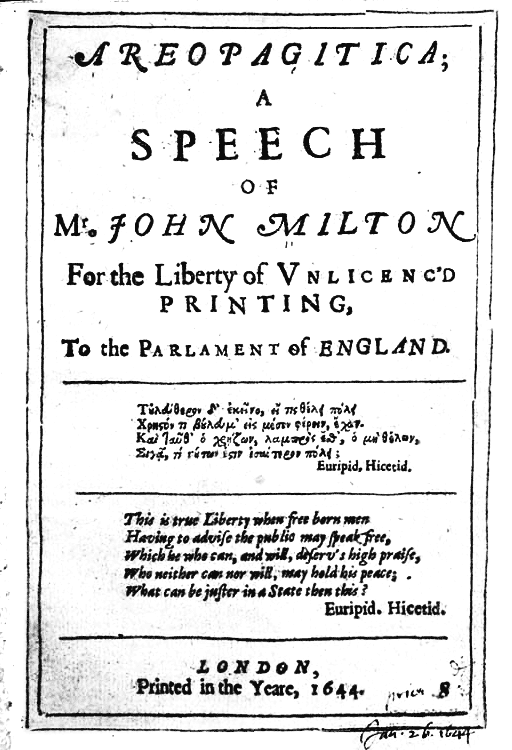
Enjoy Freedom of Speech? Thank John Milton


A good book is the precious lifeblood of a master spirit, embalmed and treasured up on purpose to a life beyond life.
……………………….—  John Milton

On June 14, 1643, the Parliament of England passed a Licensing Order that put publishing under government control.  The Order forced authors to submit their work to official censors for approval before publishing.

The Order was intended to preserve the publishing monopoly held by The Stationers’ Company, but in effect and in practice, it gave the government authority to control free thought via rigid censorship.

John Milton, who later wrote the epic poem Paradise Lost was called to action when he felt the strong arm of government enforcement after publishing his writings in favor of divorce.  In response he wrote Areopagitica, a passionate and enduring essay on the right to freedom of speech and expression.  Civil liberty, Milton reasoned, is attained through the open discussion of ideas and grievances.

Areopagitica, though widely acknowledged, had little influence on Parliament’s Order, but its importance was never forgotten.  The essay has endured as one of the most important and influential essays of free speech ever written, and it was crucial in the development of the First Amendment of the Constitution:

Congress shall make no law respecting an establishment of religion, or prohibiting the free exercise thereof; or abridging the freedom of speech, or of the press; or the right of the people peaceably to assemble, and to petition the Government for a redress of grievances.

United States Constitution – Amendment 1

In its eloquence, Areopagitica says that truth, all truth, need only to be heard, openly and fairly, to assure its victory over ignorance.

That is a timeless truth.

If you’re as uncertain about the pronunciation of Areopagitica as I was, this YouTube video can help.

Happy Birthday to Anne Frank and her Diary

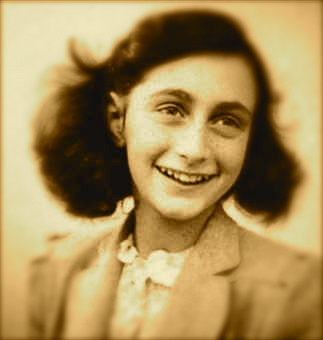
On June 12, 1942, 68 years ago today, Otto Frank gave his daughter, Anne, a diary for her 13th birthday.

Anne began a chronicle of her life that day and wrote most of her diary in hiding at the Secret Annex, a tiny hidden compartment behind a bookcase at her father’s office, where her family and four others were forced into hiding from the Nazis.

Anne wrote about the difficulties of living with eight people in such a confined and secret space. She shared her fears of being discovered by the Nazis.  And she wrote about her life as any 13 year old girl would, the excitement and confusion, the hopes and disappointments.

Anne’s dairy ended on August 1, 1944.  Three days later, the German Security Police followed an anonymous tip and raided the Secret Annex arresting everyone there.  Anne, her sister Margot, and their mother Edith were eventually sent to Auschwitz along with one thousand other women.  Half were sent directly to the gas chambers.  Anne, Margot, Edith, and the remaining 500 were forced to strip and be disinfected, have their heads shaved and their arms tattooed with an identifying number.

Edith died at Auschwitz after Anne and Margo were moved to Bergen-Belson.  Seven months later, Anne watched her sister die of typhus.  She died one week later, just a few weeks before the camp was liberated by British troops on April 15, 1945.  Only Anne’s father survived.

The Diary of a Young Girl, Anne Frank’s diary, has been translated into 67 languages and is one of the most widely read books in the world.

Its importance is noted in its inclusion on these lists:

Anne’s work speaks for itself.  It puts a human face, a young girl’s face, on the unimaginable suffering of the Holocaust.  We are graced by it because Anne Frank put her words on paper.

There’s Just Something About a Quote

…They are tiny flashes of inspiration, illumination, humor, hope. After reading one that resonates, I feel a connection, not just to the writer, but to the world. It’s a shared experience that reminds me I’m not alone out here. So for that reason, I created this page: To share some of that “inspiration, illumination, humor, hope” with you. See that? I just quoted myself!

Originally, I planned on including only quotes about writing, but I don’t want to restrict it that much. Those quotes will be included here, and will probably be in the majority, but I decided to also include any quote that floats my boat, as it were.

I invite you to add your favorites, of if you have a link to great quote site, add that, too.

To start things off, Woody Allen:

I don’t want to achieve immortality through my work. I want to achieve it through not dying.

Isaac Babel: No steel can pierce the human heart so chillingly as a period put just at the right place.

Hilaire Belloc: When I am dead, I hope it is said, “His sins were scarlet, but his books were read.”

Anton Chekhov: Don’t tell me the moon is shining; show me the glint of light on broken glass.

Jack London: You can’t wait for inspiration, you have to go after it with a club.

Flash Fiction: Dinner Music

My flash fiction for this week is “Dinner Music.” Please share any constructive criticism you can offer. To read more flash fiction from a great group of writers, search #fridayflash on Twitter or visit Mad Utopia.

Dinner Music
by Olivia Tejeda

[picapp align=”right” wrap=”true” link=”term=MRE&iid=4247012″ src=”f/f/5/0/Marines_Continue_To_8ac2.jpg?adImageId=8208227&imageId=4247012″ width=”380″ height=”255″ /]

The tedious, dawn to dusk recon was winding down and Lance Cpl. Jason Palmer said a silent thank you that he made it through another day. The nine-man squad didn’t see any action on this patrol. Nothing. But that only made the day longer and would make the night more tense. At least when you’re in combat, the adrenaline burns off with the fighting, but on a day like today, when there’s nothing but uncertainty, the pressure just keeps building and has no good outlet, at least not one that they had found so far.

The men gathered where their squad leader told them they’d bivouac for the night, and they unloaded their gear in exhausted silence. Palmer still had to dig a hole to sleep in, but his hunger won out. He stuck his hand deep into his pack and pulled out the first MRE he felt. Chili mac. Not bad. At least it wasn’t the chicken fajita. That was the worst.

Most of the squad had the same idea and by time Palmer was pouring water into his food packet he was surrounded by six other Marines tearing open their own dehydrated dinners.

“Fucking fajitas again,” Pvt. Lozano said, looking at the label on the plain cardboard box. “I can’t eat that shit tonight.” He tossed the box on the ground and dug into his pack for something else.

Pfc. Carnahan whooped. “Yes,” he said, pumping his fist in the air.

“What’d you get, Carny?” Palmer asked, surprised at Carnahan’s enthusiasm.

“Meatballs Marinara,” Carny said, smiling at the box. “My favorite.”

“Wanna trade?” Lozano said.

“Live with it, buddy. I’ve had fajitas six nights in a row,” Carny laughed. “Tonight, I got the balls.”

“Yeah, it’s the only time you got balls,” Lozano said.

Carny put the MRE down on the ground beside him. He slowly stood up, straightened himself out, and stood tall, staring at Lozano.

“To celebrate my meatballs,” he said, pointing to the foil pack on the ground, “I have some dinner music for you.”  He had never outright performed for the squad before, even though they all heard him sing. He had a beautiful voice, deep and rich, and he sang all the time. Back home, he was a member of the choir and performed in local musicals. Some of the squad made fun of him; Wheeler called him songbird, Tats called him Pavarotti, but mostly they appreciated Carny’s singing, and looked forward to the  sweet diversion that came with it.

The group quieted as Carny cleared his throat and he began:

On top of spaghetti,
All covered with cheese,

I lost my poor meatball,
When somebody sneezed.

After the first line, most of the guys were laughing, Lozano cursed at him and Palmer threw his empty MRE box, but by the end of the second line they all joined in. Mostly they didn’t know the words beyond the first verse, so as quickly as they joined in, they stopped and let Carny finish on his own.

It rolled off the table,
And on to the floor,
And then my poor meatball,
Rolled out of the door.

It rolled in the garden,
And under a bush,
And then my poor meatball,
Was nothing but mush.

The mush was as tasty,
As tasty could be,
And then the next summer,
It grew into a tree.

The tree was all covered,
All covered with moss,
And on it grew meatballs,
And tomato sauce.

So if you eat spaghetti,
All covered with cheese,
Hold on to your meatball,
Whenever you sneeze.

“Everybody finish with me,” Carny said, and they all joined in as he led them through the verse like a conductor:

On top of spaghetti,
All covered with cheese,

I lost my poor meatball,
When somebody sneezed.

They ended the verse with a flourish, as Carny raised his arms up in the air and shook his open hands like a crazed conductor leading his chorus to a deafening crescendo. They sang at full volume, each trying to out-sing the other.

As Carny signaled to end the last note, they followed his lead and burst into applause, laughing, whooping, and cheering each other.

“That was fucking great,” Lozano said still catching his breath. “Hey, Carny, Do you know the other one?” he asked. ‘The real one?”

“No, that shit’s a bummer,” Carny said. “You don’t want to hear that.”

“Yeah, we do. Come on sing it,” Lozano goaded him. The squad cheered him on, chanting, “Carny, Carny,” so he went ahead.

On top of Old Smokey,
All covered with snow,
I lost my true lover,
For courting too slow.

For courting’s a pleasure,
But parting is grief,
And a false-hearted lover,
Is worse than a thief.

A thief will just rob you,
And take what you have,
But a false-hearted lover,
Will lead you to your grave.

The grave will decay you,
And turn you to dust,
Not one girl in a hundred
A poor boy can trust.

They’ll hug you and kiss you,
And tell you more lies,
Than crossties on a railroad,
Or stars in the sky.

So come ye young cowboys,
And listen to me,
Never place your affection
In a green willow tree.

For the leaves they will wither,
The roots they will die,
And you’ll be forsaken,
And never know why.

After Carny sang the last line, there was no applause. Palmer had stopped eating and was staring blankly out into the distance. Tats was looking down, his head resting heavily in his hands.  Wheeler turned his back. Carny stood there lost in his own thoughts, wondering if the lyrics were true. Hoping they weren’t.

Only Lozano spoke up. “Why’d you sing that shit?” he asked.

“Oh, fuck it,” Carny sighed.

He sat down among his fellow Marines and they finished their MREs in silence.

© Olivia Tejeda and Liv Loves Lit, 2008-2009. Unauthorized use and/or duplication of this material without express and written permission from this blog’s author and/or owner is strictly prohibited. Excerpts and links may be used, provided that full and clear credit is given to Olivia Tejeda and Liv Loves Lit with appropriate and specific direction to the original content.

William Safire's Great Rules of Writing

In memory of William Safire …

“Great Rules of Writing”

Do not put statements in the negative form.

And don’t start sentences with a conjunction.

If you reread your work, you will find on rereading that a great deal of repetition can be avoided by rereading and editing.

Never use a long word when a diminutive one will do.

Unqualified superlatives are the worst of all.

De-accession euphemisms.

If any word is improper at the end of a sentence, a linking verb is.

Avoid trendy locutions that sound flaky.

Last, but not least, avoid cliches like the plague.

— William Safire