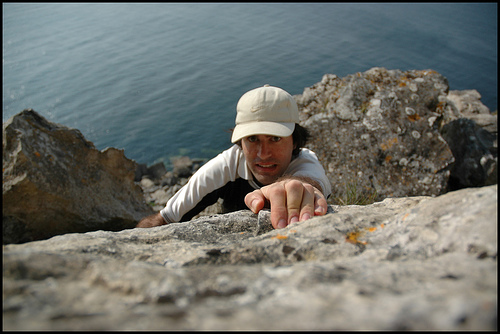
A Thousand Words: On the Rocks

Image courtesy of  Jason Rogers on Flickr. Some rights reserved.

A Thousand Words is a weekly photo prompt posted every Sunday.  Maybe the images will inspire you to write a short thriller, a haiku, a blog post, a travelogue.  Maybe you’ll just sit back and enjoy the photo.   Whatever your response, I hope you enjoy the picture and that it inspires you to creative zen.

If you write something based on the image, feel free to share a link in the comments section.   Also feel free to use the photo on your blog, just be sure to give proper credit, which I will always include in the post or the caption.

Resources: Creative Commons, Flickr, The Daily Post

99 Y.O. Self-Published Poet’s Mega-Bestseller

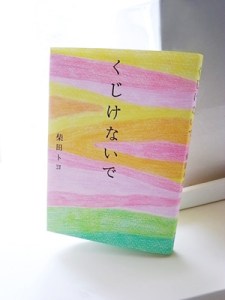
Japan’s Toyo Shibata was 92 when she started writing poetry.  Her self-published anthology, “Kujikenaide,” (Don’t Lose Heart) has sold 1.5 million copies in Japan since its publication in 2009.  With sales like that, I’m sure American publishers will take note.  Now that her story has been published in Reuters and is being picked up by mainstream media around the world,  I’m hopeful that it’s only a matter of time before her book hits the shelves in the U.S.  I definitely plan to be in line to buy it.

For more information, here’s “A Little Encouragement” from the blog, From Tokyo to the World.

A Little Encouragement Few people can say they’ve lived as long as Toyo Shibata [柴田トヨ]. At 99, she has seen two world wars, four emperors and 81 prime ministers. Over the span of such a long life, one would hope to acquire valuable wisdom about the world and how to be happy. Ms. Shibata has. She is the author of a bestselling anthology of poetry published early last year with the title “くじけないで,” or “Don’t Be Frustrated” [though I would translate it as more like “Hang i … Read More

Resources: The Daily Post, The Book Bench, From Tokyo to the World

Better Him Than Me! A Silent Writers’ Prompt

Tonight at 9 EST and PST, the Silent Writers Collective holds its weekly online writing retreat.  All writers are welcome to join in and be quiet.

You can work on your own project or use the writing exercise provided below.  For those participating in the WordPress.com Post A Day challenge, it’s a great time to stockpile a post or two.  For those who aren’t sure what they want to work on, here is an interesting exercise for fiction writers from Poets & Writers’ new series, “The Time is Now.”


… “impending doom arrives.”     Oops! Sorry, the last line was cut.

For poets:

Resources: Silent Writers Collective, PW.org, Post A Day.

Monday Motivator: Virginia Woolf’s Wild Horses

◊ ◊ ◊

“Blame it or praise it, there is no denying the wild horse in us.”
— Virginia Woolf
from “Jacob’s Room”

◊ ◊ ◊

I chose this quote in honor of Virginia Woolf’s 129th birthday, tomorrow, January 25.  What do the words evoke in you?

The Monday Motivator is a weekly quote posted to encourage, inspire, and motivate writers of all skill levels and across genres. If you have a favorite quote to share, I’d love to include it.  Click here to see past Monday Motivators.

Resources:  The International Virginia Woolf Society, The Daily Post

A Thousand Words: The Sound of Laughter

Image courtesy of lolololori on Flickr.  Some rights reserved.


A Thousand Words is a weekly photo prompt posted every Sunday.  Maybe the images will inspire you to write a short story, a haiku, a blog post, a love note.  Maybe you’ll just sit back and enjoy the photo.   Whatever your response, I hope you enjoy the picture and that it inspires you to creative zen.

If you write something based on the image, feel free to share a link in the comments section.   Also feel free to use the photo on your blog, just be sure to give proper credit, which I will always include in the post or the caption.

Resources: Creative Commons, Flickr, The Daily Post

Robert Frost Does it Right at JFK’s Inauguration

John F. Kennedy and Robert Frost blowing in the wind at JFK's Inauguration. Photo by Life

Fifty years ago today, Robert Frost made literary history by being the first poet to read at a Presidential Inauguration.

John F. Kennedy asked Mr. Frost to read a piece of his work.  As the Inauguration Ceremony approached, the poet understood the importance of the moment and decided to recite “Dedication,” a poem he wrote specifically for the occasion.

A full-fledged blizzard the night before, left the city frozen in a blanket of white.  Although the sun was shining on Inauguration Day, sub-zero temperatures and whipping winds stayed on, causing delay after delay.

When it was finally time to recite his poems, Mr. Frost took the podium.  Bundled in a long wool coat and thick scarf,  the wind blew his hair in every direction.  He began reciting “Dedication” but stumbled and stopped.  The sun’s glare reflecting off the snow made it impossible to read his new poem.

Rather than falter through a botched recitation, Mr. Frost changed direction.  He put his plan and his poetry aside, and recited “The Gift Outright” from memory.

Reading the words of “The Gift Outright,” I’m excited and astonished, again, at the inherent genius of art.  How appropos those words are for the occasion.  I’m also inspired by Mr. Frost’s action.  He knew what was most important. He put his ego and his poetry aside and did what should have been done for the occasion.

I’m sure I would have done the same on the spot.  It’s afterward that I wonder about.  Would I have pouted, whined? “Waaaa, I put a lot of work into that poem.  Stupid snow ruined everything.  My life suuuuuckkkkks!”

Past experience tells me I would be whining.  It’s a character flaw I need to work on.  A lot of artists and writers I know would whine; we’re a needy neurotic bunch. (Kanye West keeps coming to mind.)  Robert Frost didn’t whine though.  He took the road not taken and that made all the difference.

Resources: John F. Kennedy Inaugural Ceremony, Robert Frost, “The Road Not Taken,” The Daily Post

Happy Birthday, Edgar Allan Poe

“Words have no power to impress the mind
without the exquisite horror of their reality.”
— Edgar Allan Poe

The Masque of the Red Death
Image by ProfessorMortis via Flickr

Mention his name and goth girls swoon, black cats hiss, and the timid turn away.  Edgar Allan Poe was born January 19, 1809.  More than 200 years after his birth, cities still fight for ownership of the dead writer’s corpse, whose tortured life and mysterious death were as strange as the tales he told.  Tales like “The Cask of Amontillado,” “The Tell-Tale Heart,” and “The Masque of the Red Death” still have the power to shock and enthrall readers all these years later.

In pop culture, Mr. Poe is most often revered as the master of the macabre, but his pen and his influence reach far beyond that.  He and Nathaniel Hawthorne are credited as the fathers of the American short story.  “The Murders in the Rue Morgue” was the first detective story and created the genre.  “The Balloon Hoax” was an early form of science fiction and was an inspiration for Jules Verne’s “Around the World in Eighty Days.”  His poem, “The Raven” is still one of the most famous poems ever written.

He was born in Boston, was orphaned at age three, and taken in by the Allen family of Richmond, Virginia.  His older brother Henry died young and his sister Rosalie went insane.  He lived in Philadelphia with his wife and mother-in-law, before moving with them to the Bronx, New York.  He was married only once, to his 13-year old cousin Virginia Clemm, who died at age 24 of tuberculosis.  He was an alcoholic and a drug addict and was labeled paranoid and perverse.  The day before he died, he was found on a Baltimore street, delirious, incoherent and wearing clothes that weren’t his.

All five cities have landmarks or museums dedicated to him and the Poe Wars over who gets his corpse (Baltimore has it now) aren’t cold yet.

edgar-allan-poeIn honor of his birthday, I’m happy to share this fantastic party favor, a make-your-own Edgar Allan Poe doll, courtesy of the Toy-A-Day blog. (Caveat: Lots of pop-ups, but definitely worth it.) Mr. Poe might roll his eyes at the frivolity of the gesture, but I like to think it would make him crack a smile.

Resources: Post A Day, Edgar Allan Poe Museum/Richmond, Edgar Allan Poe National Historic Sity/Philadelphia, Edgar Allen Poe Cottage/The Bronx, Edgar Allan Poe Society/Baltimore.

Writing Prompt for Tonight’s Silent Writers’ Retreat

William Faulkner's Underwood Universal Portabl...
Image via Wikipedia

Tonight at 9 EST and PST, the Silent Writers Collective holds its weekly online writing retreat.  All writers are welcome to join in and be quiet.

You can work on your own project or use the writing exercise provided below.  For those participating in the WordPress.com Post A Day challenge, it’s a great time to stockpile a post or two.  For those who aren’t sure what they want to work on, here is an interesting exercise from Poets & Writers’ new series, “The Time is Now.”

This exercise may be more writing than you can fit into one hour, but if you’re inspired to keep writing, that’s the whole idea!

As J-Lo would say, I’m “Waiting for Tonight!”

Resources: Post A Day, Silent Writers Collective, PW.org

Monday Motivator: Elizabeth Barrett Browning

“Light tomorrow
with today!”

— Elizabeth Barrett Browning

◊ ◊ ◊

On December 10, 1845, Robert Browning wrote a letter Elizabeth Barrett, a well-known poet who had praised the younger writer’s work in print.

The letter opens with Mr. Browning’s gushing praise. “I love your verses with all my heart, dear Miss Barrett — and this is no off-hand complimentary letter that I shall write.”

The gushing continues.  “I do, as I say, love these books with all my heart — and I love you too.”

Cheeky!

Writers today might call security over that last line, but the next day, Miss Barrett, who was bedridden with respiratory illness and six years older than Mr. Browning, wrote to a friend, saying Browning’s letter “threw me into ecstasies.”

That’s how England’s greatest literary love affair began and we are all richer for it.  Although Barrett’s tyrannical father refused to allow any of his 12 children to marry, Elizabeth and Robert carried out their romance in secret and eloped four years later.  Her father refused to see her again.

During their secret courtship, Elizabeth wrote “Sonnets from the Portuguese,” which includes the now practically cliched line, “How do I love thee, let me count the ways.”

If you haven’t had the good fortune to read the most famous love poem of all time, here it is.  Enjoy.

Sonnets from the Portuguese, XLII
How do I love thee?  Let me count the ways.
I love thee to the depth and breadth and height
My soul can reach, when feeling out of sight
For the ends of Being and ideal Grace.
I love thee to the level of everyday’s
Most quiet need, by sun and candlelight.
I love thee freely, as men strive for Right;
I love thee purely, as they turn from Praise.
I love thee with the passion put to use
In my old griefs, and with my childhood’s faith.
I love thee with a love I seemed to lose
With my lost saints,—I love thee with the breath,
Smiles, tears, of all my life!—and, if God choose,
I shall but love thee better after death.
— Elizabeth Barrett Browning

The Monday Motivator is a weekly quote posted to encourage, inspire, and motivate writers of all skill levels and across genres.  I’d love suggestions if you have a favorite quote to share.  Click here to see past Monday Motivators.

Resources:  The Brownings,Robert Browning’s letter, Sonnets from the Portuguese (free download all e-book formats), PostADay2011

An Aha Moment Ends Reign of Old Excuses

The new NFL logo went into use at the 2008 draft.
Image via Wikipedia

It’s a big football weekend, and we’re in the middle of Day 2 of the NFL being broadcast (loud and clear) across our living room.  I’m not a big sports fan in general, but I do get caught up in the excitement of playoff season, regardless of the sport.   To be completely honest, I get excited over any excuse to make cocktail meatballs and pigs in a blanket, which is what Hon and I are feasting on today.

Speaking of sports, I was overwhelmed by the response to the YouTube link I posted yesterday.   I found Matt Scott’s Nike commercial incredibly inspiring, and I was so happy to learn that many of you did, as well.

Last night when Hon and I were talking about it, he said he thought it would be motivating to have the list of excuses that Matt Scott runs through.  I think that’s a great idea.  It’s a tangible example of the countless reasons we come up with to stop us from doing what we could be doing.  And it ends with a stunning “Aha Moment” that showed me excuses are just that … excuses.

So here is the script, as transcribed by me, of Warhawk Matt Scott in Nike’s No Excuses commercial:

I’m too weak
Too slow
Too big
I ate too much for breakfast
I’ve got a headache
It’s raining
My dog is sick
I can’t right now
I’m not inspired
Makes me smell bad
I’m allergic to stuff
I’m fat
I’m thin
It’s too hot
I’m not right
I’ve got shin splints
A headache
I’m distracted
I’m exerting myself too much
I’d love to really, but I can’t, I just can’t
My favorite show is on
I’ve got a case of the Mondays
… the Tuesdays,
… the Wednesdays
I don’t wanna do this
I wanna do something else
After New Years
Next Week
Might make a mistake
I got homework
I feel bloated
I have gas
I got a hot date
My coach hates me
My mom won’t let me
I bruise easily
It’s too dark
It’s too cold
My blister hurts
This is dangerous
Ugh
Sorry, I don’t have a bike
I didn’t get enough sleep
My tummy hurts
It’s not in my genes
I don’t wanna  look all tired out
I need a better coach
I don’t like getting tackled
I have a stomachache
I’m not the athletic type
I don’t wanna get sweaty
I have better things to do
I don’t want to slow you down
Do I have to do this?
As soon as I get a promotion
I think I’ll sit this one out
And my feet hurt.

I’ve thought of a few of my own excuses, as I’m sure you could too, but now I’ve had that Aha Moment, and that will make it harder to fall back on old excuses.  Thanks, Mike!

Resources: Daily Post